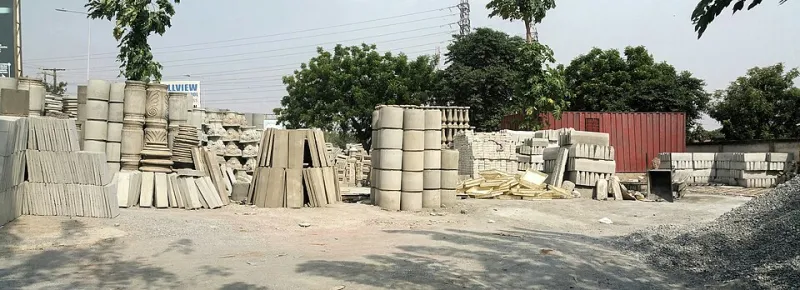
Time Is the Most Expensive Material on Any Job Site — Precast Concrete Is Changing That Math
Photo: Jorge Láscar from Melbourne, Australia, CC BY 2.0, via Wikimedia Commons
The Clock Is Already Running When You Break Ground
Here is an uncomfortable truth that experienced project managers already know: the moment a construction project begins, money is leaving the budget whether or not productive work is happening on site. Financing costs accumulate daily. Site overhead — supervision, equipment rental, temporary utilities, security — does not pause for weather delays, subcontractor no-shows, or concrete cure times. Every day a commercial building sits unoccupied is a day of lost rental revenue. Every week a public infrastructure project runs over schedule is another week of political pressure, contractor penalties, and public inconvenience.
Schedule is not just a project management metric. It is a financial variable with direct impact on project profitability and stakeholder satisfaction. Yet the construction industry has historically treated it as something to manage after the fact rather than engineer from the beginning.
That mentality is changing — and precast concrete is a significant reason why.
The Problem With Building Everything in Place
Cast-in-place concrete construction has served the industry well for generations. It is flexible, adaptable, and familiar to virtually every contractor in the country. It is also slow.
Pour a concrete foundation, and you wait. Wait for formwork setup, wait for the pour, wait for initial set, wait for cure, wait for form removal, wait for inspection. Each step creates a dependency that pushes the next trade further down the schedule. In a multi-story commercial or industrial project, these wait cycles compound. A realistic cast-in-place concrete structure on a mid-size commercial project might consume 40 to 60 percent of the total project schedule before the building is even weather-tight.
That is time the owner is paying for without receiving a usable building. That is time the contractor is paying for in site overhead. That is time the lender is collecting interest on.
Precast concrete attacks this problem at its source by moving the most time-intensive production steps off the critical path entirely.
What "Off the Critical Path" Actually Means in Practice
When precast components are manufactured in a controlled factory environment while site preparation and foundation work proceed simultaneously, the project is effectively running two parallel workflows instead of one sequential chain. This is not a theoretical efficiency — it is a documented schedule compression mechanism that consistently delivers measurable results.
Industry data from projects using precast structural systems consistently show schedule reductions in the range of 30 to 40 percent compared to equivalent cast-in-place approaches. On a project originally scheduled for 18 months, that represents five to seven months of recovered time. On a project with a $500,000 monthly overhead burn rate, that recovery translates directly to $2.5 to $3.5 million in avoided costs — before accounting for the value of earlier building occupancy.
Consider a practical example from the commercial warehouse sector, one of the fastest-growing construction segments in the United States. A 200,000-square-foot distribution center using precast wall panels, hollow-core floor slabs, and precast structural columns can reach weather-tight status in a fraction of the time required for a comparable cast-in-place structure. Erection crews working with engineered precast components can install and connect structural elements at rates that simply are not achievable with traditional forming and pouring methods.
The Labor Equation That Developers Rarely Calculate Upfront
Labor is the construction industry's most volatile cost variable. Skilled concrete workers command premium wages in virtually every major US market, and availability has tightened considerably over the past decade as the construction workforce has aged and new entrants have not replaced departing workers at sufficient rates.
Cast-in-place concrete is labor-intensive at every stage: formwork carpentry, reinforcing steel placement, concrete placement and finishing, form stripping, and surface repair. Each of these tasks requires skilled workers on site, exposed to weather, working within the constraints of what the site layout permits.
Precast manufacturing shifts the majority of this labor to a factory setting where conditions are controlled, productivity is consistent, and the work is concentrated rather than spread across a sprawling job site. The on-site labor requirement for precast erection is substantially lower than for equivalent cast-in-place work, and the specialized nature of the erection crew means that work proceeds efficiently without the coordination overhead of managing multiple concrete subcontractor teams simultaneously.
For project managers building labor cost models, the difference is not marginal. Depending on project type and scope, on-site concrete labor reductions of 50 percent or more are achievable when precast systems replace cast-in-place approaches.
Weather: The Schedule Risk Nobody Can Manage Away
Every contractor has a weather contingency in their schedule. What most do not fully account for is the cascading effect of weather delays on concrete-dependent work sequences. Concrete cannot be placed in freezing temperatures without protective measures that add cost and complexity. Rain delays finishing operations. Extreme heat affects cure times and can compromise concrete quality if not carefully managed.
Precast manufacturing eliminates weather as a concrete production variable entirely. Components are produced in enclosed facilities under temperature and humidity conditions that optimize concrete performance. By the time a precast element arrives on site, the most weather-sensitive production steps are already complete and documented.
On-site erection is weather-dependent to some degree, but the window of vulnerability is dramatically narrower than with cast-in-place construction. An erection crew working with a crane can install precast components in conditions that would shut down a traditional concrete pour — and they can do it faster.
Rethinking ROI: The Full Picture of Schedule Compression
The return on investment case for precast concrete is strongest when it incorporates all the schedule-related costs that traditional project budgets often treat as fixed or unavoidable.
A useful framework for project managers evaluating the precast option includes four categories of financial impact: avoided overhead costs from schedule compression, avoided financing costs from earlier project completion, revenue acceleration from earlier building occupancy or handover, and reduced weather and rework risk.
When all four categories are quantified honestly, the premium that precast components sometimes carry relative to cast-in-place material costs frequently disappears — and in many cases, the total project cost is lower with precast even before accounting for the schedule benefits.
Sumber Precast Indonesia works with US project teams during the early planning phase to develop these comparative analyses, providing the technical and pricing inputs that make the ROI calculation concrete rather than theoretical. The goal is not to sell precast as a universal solution but to help project managers make decisions based on a complete picture of the costs involved.
The Mindset Shift That Changes Everything
The contractors and developers who capture the most value from precast concrete are those who engage with it as a design and planning tool, not a material substitution. Precast works best when it is considered from project inception — when structural systems are designed around precast capabilities, when procurement timelines are built into the schedule from the start, and when the efficiency of factory production is treated as a project asset to be maximized rather than a procurement detail to be managed.
Time is the most expensive material on any job site. Precast concrete is one of the most effective tools available for spending less of it.