Fewer Moving Parts, Fewer Headaches: How Precast Concrete Untangles Megaproject Logistics

In the world of large-scale US construction — think multi-phase infrastructure corridors, commercial campuses, or regional transit hubs — the most underestimated cost driver is rarely the materials themselves. It is the coordination burden required to move dozens of different material streams from dozens of different suppliers to a single job site, on time, in the right sequence, without creating bottlenecks that ripple across the entire schedule.
Precast concrete does not just solve a material problem. It solves a logistics problem. And for US project managers navigating an era of persistent shipping volatility, that distinction is becoming one of the most compelling reasons to restructure procurement strategies around factory-manufactured components sourced at scale.
The Coordination Tax on Complex Projects
Every construction megaproject carries what experienced project managers privately call a "coordination tax" — the invisible overhead consumed by tracking, expediting, reconciling, and rescheduling materials from multiple vendors. On a typical cast-in-place concrete project, that tax compounds quickly. Formwork suppliers, rebar fabricators, ready-mix batch plants, pump operators, and finishing crews all operate on separate schedules with separate dependencies.
When one link in that chain slips — a rebar delivery delayed by port congestion, a batch plant offline due to equipment failure — the cascade effect can idle entire crews for days. According to data from the Associated General Contractors of America, schedule overruns tied to materials coordination represent one of the top three cost escalation factors on projects valued above $50 million.
Precast concrete collapses several of those supply chain links into a single managed relationship. Wall panels, structural beams, hollow-core slabs, stairwell components, and utility vaults can all be specified, manufactured, and delivered under a single procurement umbrella. The job site receives finished components, not raw inputs requiring further assembly under field conditions.
Standardization as a Logistics Multiplier
The logistics advantage of precast begins at the design stage. When structural components are engineered to repeatable dimensions and connection details — a discipline that Indonesian precast manufacturers have refined through years of producing at export scale — the downstream scheduling benefits are substantial.
Consider a mixed-use development in the mid-Atlantic region that required over 3,000 individual structural panels across four building phases. By standardizing panel geometry and connection hardware across all phases, the project's procurement team was able to batch production runs, consolidate ocean freight shipments, and build a delivery buffer inventory at a regional staging yard. Rather than managing 12 to 15 separate material deliveries per week, the site logistics coordinator was receiving two to three structured precast shipments on a published schedule.
That reduction in delivery events did not merely simplify the receiving process. It freed up crane time, reduced traffic management requirements at the site entrance, and allowed the superintendent to plan crew assignments with a level of confidence that is simply not achievable when material arrivals are unpredictable.
Why Indonesian Production Scale Changes the Equation
The ability to achieve this kind of standardization at volume depends heavily on the manufacturing capacity of the supplier. Smaller domestic precast yards in the US often face capacity constraints that force project teams to split orders across multiple producers, reintroducing the coordination complexity that precast is supposed to eliminate.
Indonesian suppliers operating at export scale — producing for multiple international markets simultaneously — carry a structural advantage here. Their production facilities are designed for high-volume, multi-SKU output with consistent quality control protocols. When a US contractor places an order for 2,000 wall panels, an Indonesian manufacturer of sufficient scale can absorb that order into a running production schedule without the lead-time volatility that smaller operations generate.
This matters enormously in the current freight environment. When shipping capacity is tight and booking windows are narrow, predictable production output allows procurement teams to lock in vessel space in advance rather than scrambling for last-minute bookings at premium rates. The supplier's production schedule becomes a planning asset, not a variable to manage around.
Inventory Management in a Volatile Freight Market
One of the more nuanced benefits of precast procurement at scale is the ability to build and manage a strategic inventory buffer without the waste typically associated with carrying excess materials on a job site.
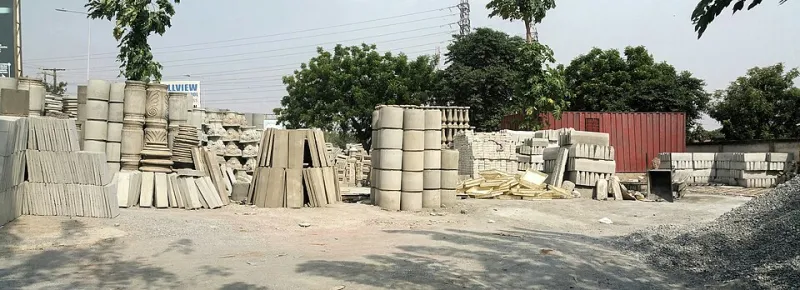
Because precast components are dimensionally stable, stackable, and do not degrade in outdoor storage conditions the way some finishing materials do, they can be held at a regional distribution yard for weeks or months without deterioration. This characteristic allows project teams to decouple production timing from installation timing — a critical capability when ocean freight schedules become unpredictable.
During the supply chain disruptions of 2021 and 2022, several US contractors who had established precast buffer inventory programs reported significantly lower schedule impact than peers relying on just-in-time delivery models. By holding four to six weeks of precast inventory at a staging facility, these teams absorbed transit delays without stopping work on the critical path.
The working capital implications require careful planning, but the schedule protection value — particularly on projects with liquidated damages clauses — often justifies the carrying cost by a considerable margin.
Simplifying the Vendor Ecosystem
Beyond the direct logistics benefits, consolidating structural components under a precast procurement strategy produces a secondary effect that project managers consistently report as undervalued: vendor ecosystem simplification.
On a traditionally sourced megaproject, the project management team may be actively managing relationships with 40 to 60 material suppliers simultaneously. Each relationship carries its own communication overhead, contract terms, invoicing cycle, and performance monitoring requirement. The administrative burden alone can absorb significant management bandwidth that would otherwise be directed at schedule execution.
A well-structured precast procurement relationship — particularly one with a supplier experienced in serving US export clients — consolidates a meaningful share of that vendor load. Shop drawings, quality certifications, delivery documentation, and technical support flow through a single point of contact. For project managers already stretched across multiple workstreams, that simplification has measurable value.
Building Schedule Predictability Back Into Large Projects
The construction industry has spent the past several years absorbing the lesson that supply chain resilience is not an optional feature of project planning — it is a fundamental requirement. The contractors who emerged from the volatility of the early 2020s with intact margins and client relationships were, in many cases, those who had restructured their procurement strategies around predictability rather than unit cost alone.
Precast concrete, sourced from suppliers with the production scale and export infrastructure to serve US project requirements reliably, represents one of the most effective tools available for rebuilding that predictability. It does not eliminate logistics complexity entirely. But it concentrates that complexity into a manageable, plannable framework — which, on a megaproject, is often the difference between a schedule that holds and one that unravels.
For US contractors evaluating procurement strategies on upcoming large-scale work, the logistics calculus around precast concrete is worth examining with fresh eyes. The savings may not show up first on the material cost line. They will show up in the schedule, in the coordination overhead, and in the project manager's ability to direct attention where it actually matters.